AI-Assisted HAZOP Study
AI-Assisted HAZOP Study
Description:
HAZOP (Hazard and Operability) studies [1,2] are a critical component of the process safety of chemical plants. HAZOP studies are traditionally conducted in expert groups and require detailed manual exploration of process deviations which consumes a lot of time.
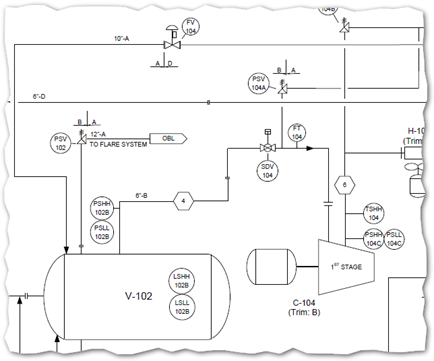
In this master thesis, large language models (LLMs) are used to assist the generation of HAZOP studies. The tasks include the fine-tuning or prompt-engineering of LLMs [3] for HAZOP-specific tasks, the integration piping and instrumentation diagrams (P&IDs) and textual information, and the evaluation of LLMs in real-world HAZOP case studies with expert feedback.
Approach:
Literature search and familiarization with the topic of HAZOP and LLM
Data Collection
- Evaluate (existing) HAZOP reports and process documents
- Annotate deviations, causes, consequences, and actions
Model Development
- Fine-tune or adapt multimodal LLM-based models with safety engineering language
- Use Parameter-Efficient Fine-Tuning (PEFT) approaches to minimize resource requirements
System Integration
- Create a prototype that accepts (P&IDs) and textual information
- Generate guidewords, deviations, and proposed consequences
Phase 4: Evaluation
- Use expert-led sessions to compare AI-assisted vs manual HAZOP tables
- Evaluate based on accuracy, completeness, and time efficiency
Supervisors:
Prof. dr. ing. M. B. Franke - m.b.franke@utwente.nl
Literature:
[1] Risk Assessment - ROSS - NTNU
[2] Kletz, T. A.: “Hazop – past and future”. Reliability Engineering and System Safety, 55:263-266, 1997
[3] How are large language models trained? Pre-training | LinkedIn Learning