A Gas-Solid experimental modelling framework for Direct Reduction of Iron
A Gas-Solid experimental modelling framework for Direct Reduction of Iron
Description:
The global steel industry currently accounts for 7-8% of the global CO2 emissions. Steel is conventionally produced through coal-based reduction, but a renewed interest in gas-based direct reduction of iron (DRI) has developed in recent years to lower the emissions. While DRI has been known for decades with use of methane, the future goals have been set for near-zero emission steel making with the use of hydrogen as the reducing agent. Challenges arise, however, as the carbon content in the DRI product must be sufficient for post-processing to produce high quality steel. Moreover, this carburization process should preferably lead the incorporation of carbon in the iron lattice, rather than giving graphite deposition on the reduced iron. Although the chemical process DRI has been around for many years, the intricacies of the reduction kinetics in combination with the gas-solid transport phenomena in varying reducing environments remains to be thoroughly understood.
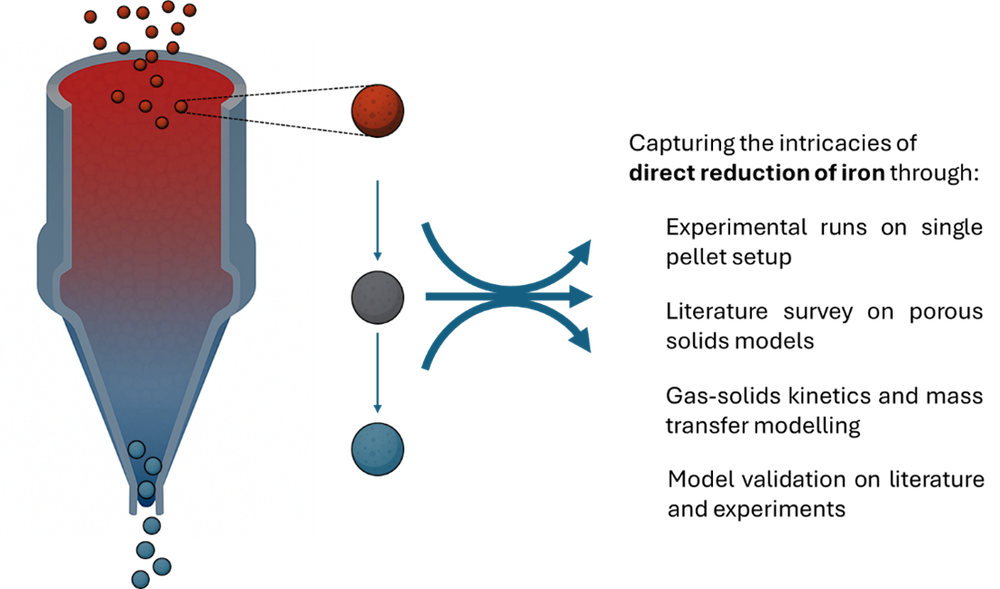
The DRI process is industrially performed in iron oxide pellets, typically measuring 10-16mm in diameter. In this project, an experimental setup has been designed to do reduction and carburization experiments on single pellets. The design philosophy of the setup is such that external mass transport can be considered negligible. Several parameters on the pellet chemistry, microstructure, gas composition, and reaction conditions have been identified to be input parameters to an experimental modelling framework to be developed on the data obtained from the single pellet experiments.
In this assignment, it is aimed to fit existing literature models on porous solid media to the experimental data obtained from the available setup. Activities as part of this assignment are:
- Conduct a comprehensive literature review on porous solid–gas reaction models.
- Develop and refine mathematical models of solid-gas reactions and transport.
- Perform single pellet experiments to generate high-quality data.
- Validate your findings against own experiments and existing literature and identify pathways for improvement of the developed models.
Supervisors:
Niklas Slager (daily supervisor) - n.slager@utwente.nl
Sascha Kersten (professor) - s.r.a.kersten@utwente.nl